Table of contents
Hide sections Show sections
At a glance
| Problem | Aurasell, an AI-native go-to-market platform, needed its sales-engagement layer built before launch. |
| My role | First frontend engineer. I owned the sales-engagement frontend from pre-launch to GA, working with the Go backend and design teams, across 370+ PRs. |
| Result | 50+ customers at GA. The AI email composer runs on 16+ screens, with the first words appearing in 3-4s. |
| Stack | Next.js, React, TypeScript, SSE, ReactFlow, IndexedDB |
Architecture
Key decisions
Streaming AI output, with a polling fallback alongside it
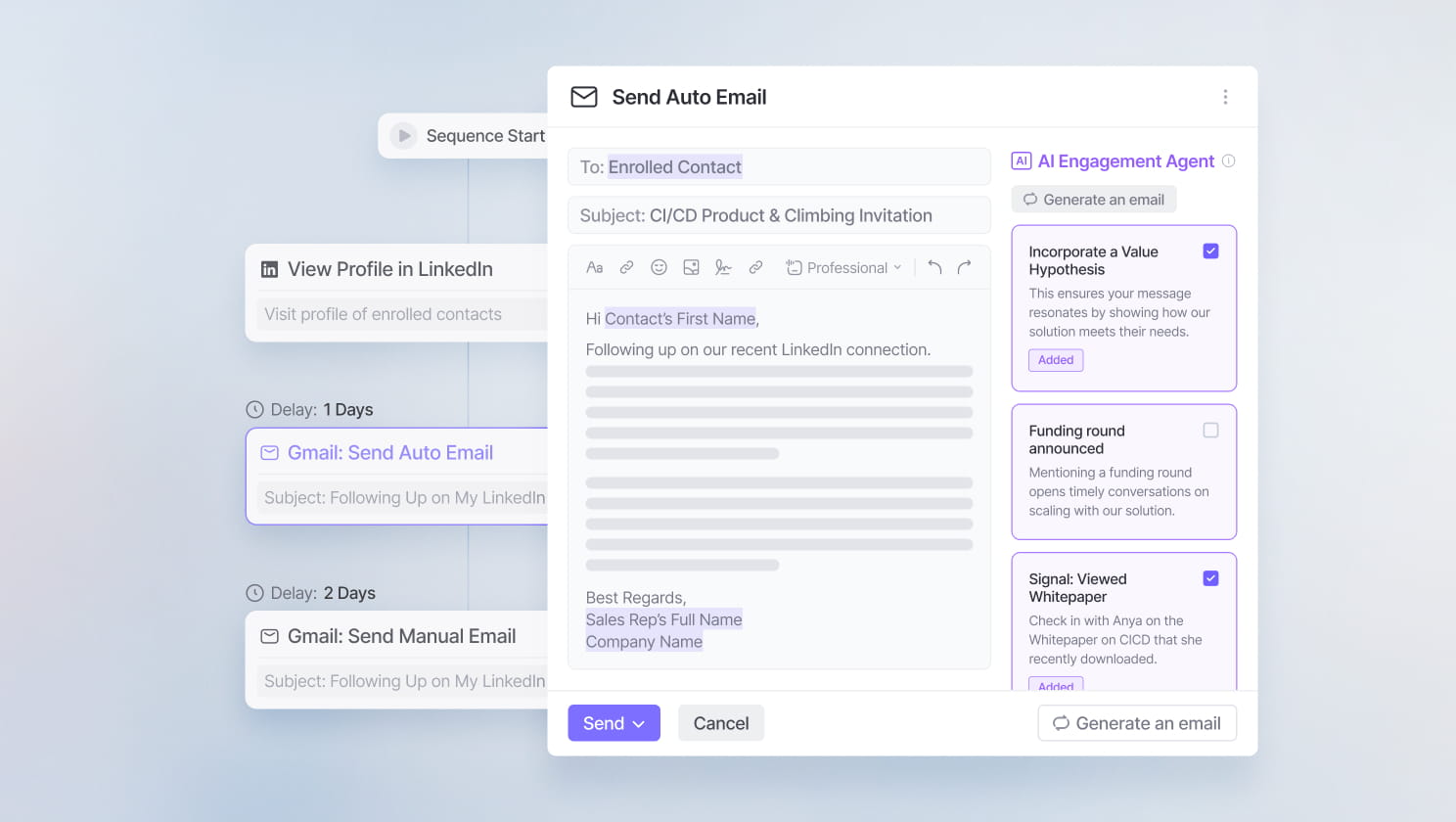
The AI email composer inside a sequence step. Suggestions from the AI Engagement Agent sit beside the draft.
| Decision | Stream tokens to the composer over server-sent events, and run a polling request in parallel so the user still gets the result if the stream never arrives. |
| Alternatives | Waiting for the full response (20-40 seconds of blank screen), or SSE on its own. |
| Why | Some customers sit behind corporate proxies that inspect SSL and silently buffer or drop event streams. With SSE alone, the AI looked broken for exactly those enterprise users. |
| Cost | Two code paths to keep consistent, and some extra requests. In return, the first words show up in 3-4 seconds, and the fallback protects four AI features: email, LinkedIn, call prep and chat. |
Keeping table state out of the URL, and dropping iframes
| Decision | Hold table filters, sorting and paging in client state instead of the URL query, and render the views directly instead of embedding them in iframes. |
| Alternatives | Keeping URL-driven state, which can be shared as a link but re-renders every table on each change. |
| Why | Routes carried several large tables, so changing one table re-rendered all of them, and the iframes doubled the loading cost. |
| Result | Page load time down 75%. |
A local-first sequence builder
| Decision | Keep the sequence graph in IndexedDB and edit it on a ReactFlow canvas, with no server round trip per change. |
| Alternatives | Saving every edit to the server. |
| Why | Reps edit long, multi-step sequences, and a network call on every node move felt slow. |
| Cost | Syncing and conflict resolution become the frontend’s problem. |
Result
- 50+ customers at GA.
- AI emails start appearing in 3-4 seconds instead of after a 20-40 second wait.
- Page load time down 75% on routes with large tables.
- Two shared platform modules: a TipTap editor (a 2,500+ line refactor, now used on 51 screens) and a file-upload manager written as a typed state machine, used in 14 areas.
- LinkedIn outreach turned from a manual “do this on LinkedIn” task into a tracked channel for messages, InMail and connection requests, with rate limits tied to each rep’s plan to protect their accounts.
Hiring for a senior frontend role?
I'm open to remote or hybrid (Bengaluru) senior frontend roles and available immediately.